

By Jonathan Mbiriyamveka
VICTORIA FALLS – In a historic moment for African tourism, Zimbabwe today became the first country in the world to unveil the official UN Tourism logo for the International Year of Sustainable and Resilient Tourism 2027, as the continent’s tourism leaders declared a decisive shift from symbolic commitments to structural transformation.
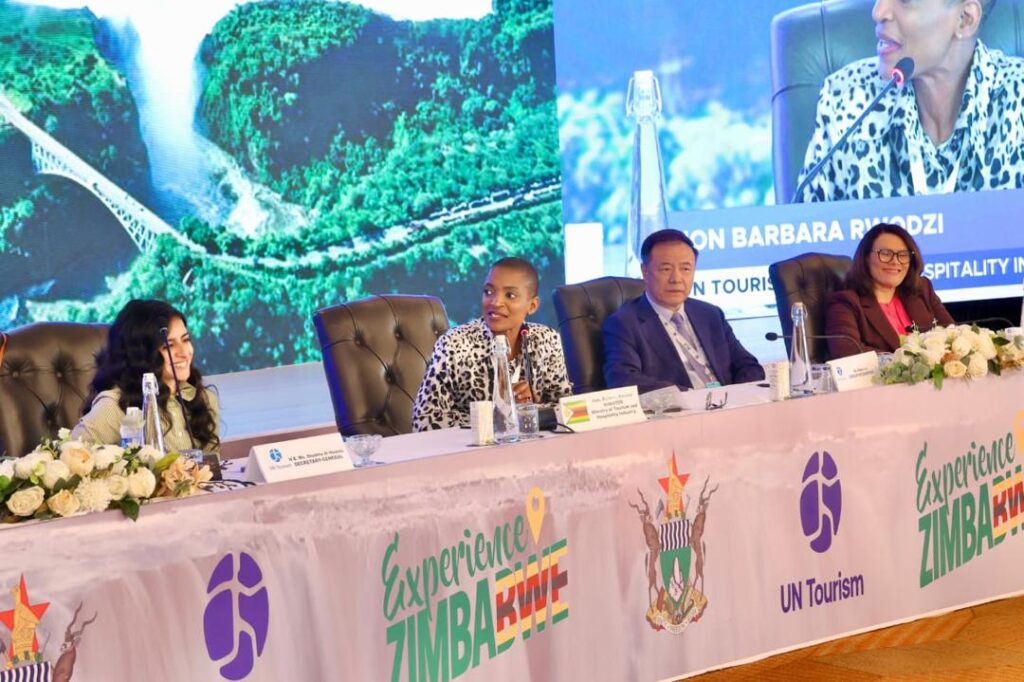
The emblem was revealed during the opening of the 23rd UN Tourism Committee on Sustainable Tourism Meeting, held under the theme “Advancing from Empowerment to Leadership: Driving Structural Change in the Tourism Sector in Africa.”
The logo, which will be used by the United Nations General Assembly to commemorate the 2027 international year following its proclamation in 2024, signals a unified global direction.
All UN Tourism programmes and initiatives are now expected to align towards sustainability and resilience in the lead-up to 2027—a milestone year that Zimbabwe is set to co-host.
But beyond the ceremonial unveiling, it was the UN Tourism Secretary-General’s sharp rebuke of business-as-usual that set the tone for the gathering.
Her Excellency Shaikha Al Nuwais, UN Tourism Secretary-General, told delegates that the Committee on Sustainable Tourism’s mandate has been misunderstood for too long.
“This Committee’s mandate is far from symbolic,” she said in her keynote address. “It is instrumental in shaping a sustainable, resilient and future-ready tourism sector across the continent.”
The choice of words was deliberate. Tourism officials across Africa have long complained that high-level meetings produce declarations that rarely translate into on-the-ground change. Al Nuwais appeared to directly address that frustration.
“We are moving from empowerment to leadership,” she said. “Empowerment means giving tools. Leadership means wielding them. Africa must now wield its own tools.”
Delivering host nation remarks, Zimbabwe’s Minister of Tourism and Hospitality Industry, Hon Barbara Rwodzi, expressed profound appreciation on behalf of President Emmerson Mnangagwa for the honour of hosting the prestigious gathering.
She also paid special tribute to the country’s Tourism Patron, Her Excellency the First Lady Dr. Auxillia Mnangagwa, for her unwavering commitment to sustainable tourism and her work in empowering communities to safeguard the nation’s heritage.
“Zimbabwe does not take this responsibility lightly,” Rwodzi said. “To be the first to unveil a UN global symbol is to be the first to be held accountable for what it represents.”
Behind the rhetoric, delegates indicated that “structural change” would likely involve revisiting tourism revenue retention policies, pushing for more local ownership of hospitality assets, and tying international investment to measurable resilience benchmarks—such as climate adaptation plans for heritage sites like Victoria Falls itself.
The meeting continues through the week, with technical sessions expected to produce a roadmap for African member states to align their national tourism strategies with the 2027 sustainability targets.
For now, the new logo—featuring interlocking green and blue motifs symbolizing nature and water resilience—flanked the stage as a reminder that the clock is ticking.
“Three years is not a long time,” Al Nuwais cautioned. “But if we lead, not just talk, it is enough.”
About Author

