

BY DR. TONY M. MONDA
Zimbabwean artist Esop Tshovu-Tshovu is an Indigenous Impressionist painter who works in an explicitly figurative tradition. His purpose is to celebrate modern urban and rural culture by depicting imagery recorded from life.
His painted scenes of populous, colourful crowds are notable for their careful delineation and stylised distortion.
Tshovu-Tshovu’s work opens our eyes to the beauty of what we see -countless times every day without the inner thrill. Groups of people humble, anonymous and busy, forming agitated patterns of colour within still motionless backgrounds constitute the artist’s visual legibility and style.
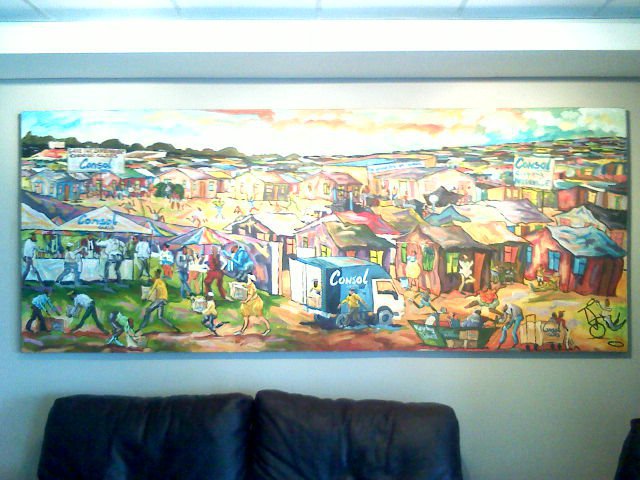
What are normally termed proverbial genre scenes in Western art are given dynamic new meaning in his renderings of the Zimbabwean urban milieu. He is also known for his masterly paintings of village and urban life and his understanding of the human condition within their habitats.
The artist’s works have continued to develop with a new freedom in large free-standing figures, less busy, than previous works and with more emotional intensity. Brightly coloured and bold in mood, the works combine a graceful style replete with gestural animation.
Using a type of neo-impressionist pointillism Esop applies areas of pure rich colour straight onto the canvas so that at a certain distance they fuse in the viewer’s eye, producing more vibrant colour effects than if the pigments had been physically mixed together.
These elements inspired by Seurat can also be seen in his superb draughtsmanship and tonal drawings in biro ink and conte crayon.
Rather than conveying the sense of brevity attached to the particular moment and scene that he paints, the artist manages to paint enduring moments of life in his exhaustive applications of optical colour theories in his work.
His compositions ensure balance and harmony and convey a specific mood through the overall forms.
His portraits are sharp and lucid with careful attention paid to details of clothing as well as the subject’s physiognomy. His poses are decidedly culturally Zimbabwean.
He exploits the psychological properties of line, colour and tone and his works have attracted a huge following in corporate circles in South Africa as well as being one of the first artists to be commissioned by Zimpapers Limited, in Harare, Zimbabwe.
Some of his work can also be seen at the Mega Mica Shopping Mall in Four Ways -, Norscott Manor, Rosebank Mall, and at the Rooftop Market Mall, in South Africa. He won the “Proudly South African” Award of Honour in 2007, for his artworks in which he demonstrated his mastery of space and movement in his highly personal images of animated figures in high density suburbs.
Tshovu-Tshovu has also won the “Most Eccentric Award” in 2008, for his painting “Black like Us” in Johannesburg.
Born in Harare, on 23 March, 1979, Esop Tshovu-Tshovu is the son of Norman Tshovu-Tshovu, a founder member of the Harare Art Centre with Charles Fernando and Kingsley Sambo.
His father, Norman Tshovu-Tshovu worked as a display and graphic artist for the Zimbabwe National Army from 1979 to 1992.
Similarly young Esop worked as a display artist for Barons men’s outfitters in 1997 to 1998, Meikles Department Store from 1999 to 2000, and Woolworths Zimbabwe.
In 2003 and 2005 he participated in “The Gun Free South Africa” art exhibitions. In 2004 he attended the VEGA School of Brand Imagination and Creativity where he undertook a corporate brand- building course.
He has since undertaken many commissions including the Hotel Michelangelo’s Penthouse suite, the Life Hospital in 4-ways, Bladeworx Stone Wedge Office in Bryanston, the Cosmo City Medical Centre, Johannesburg, and at the Whirlpool Washing Machine Works, in both Johannesburg and Cape Town.
Tshovu-Tshovu has also been commissioned by The Patriot Newspaper, Nicoz Diamond, William Smith and Gourack, and Zimpapers. He has since undertaken several private and commercial commissions in Zimbabwe, South African companies and the region.
Tshovu-Tshovu says: “Zimbabwe’s branding strategy lacks impetus because they have ignored the importance of the visual arts which contribute to the public’s perception of their company and their contribution to society – more companies in Zimbabwe should emulate some of Zimpapers management staff who have encouraged corporate art collections”.
Dr Tony Monda holds a PhD in Post-Modern Art Theory and a DBA in Post-Colonial Art and Heritage Studies. E-mail: tonym.MONDA@gmail.com
About Author

