

BY DR. TONY M MONDA
Like most of the early artists, Chaurika is an autodidactic sculptor. As a devout, resourceful and skilled craftsman, he presents us with ‘olde English’ horse breeds with thick-set limbs reminiscent of English Shires and Clydesdale plough horses, Hackney horse breeds, Cleveland Bays, Welsh Cobs and ponies and the Suffolk Punch – the five-hundred year old horse breed named after its native country.
It is a breed known for its fecundity, longevity, docility, courage and even-tempered willingness to work. The British Suffolk breed is the original epitome of the British workhorse. They became known as the agricultural horse of Great Britain. Other breeds explored by the artist include Shetland ponies, Yorkshire coach horses and the Highland Garron horse. Some of these horses were imported to Zimbabwe in the 19th century.
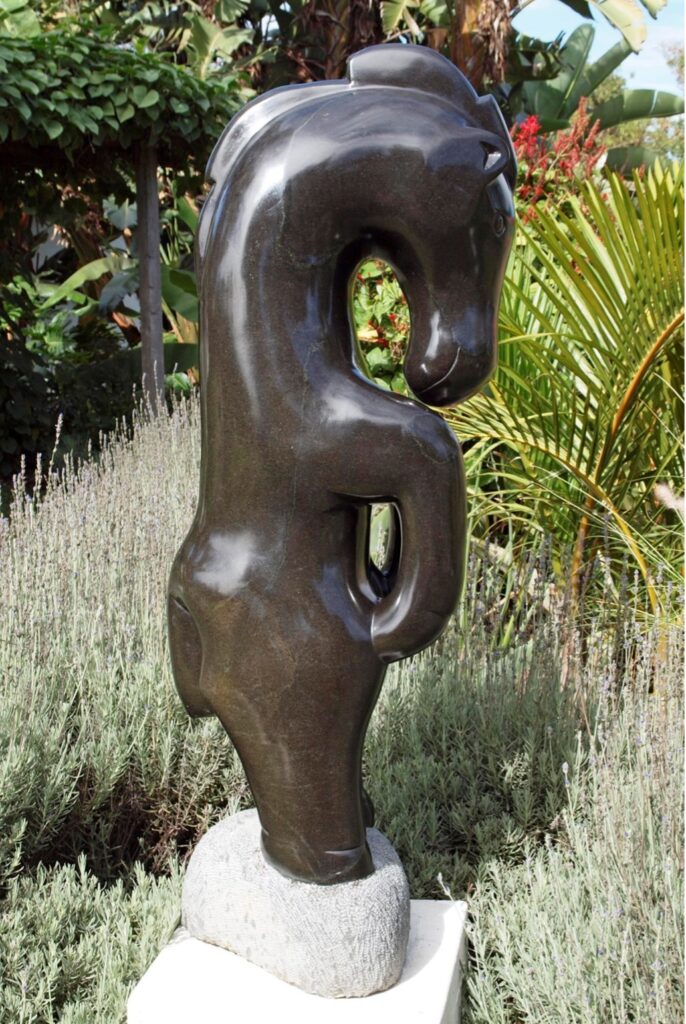
Chaurika’s Suffolk’s, carved in stone are strophic in form with the appearance not uncommon in Tengenenge immigrant art from farm labourers originating from Malawi, Zambia, Angola and Mozambique that formed the melting pot of a transient culture between the old empire and Africa, domiciled on southern African farms like Tengenenge.
Centuries ago in Zimbabwe, indigenous breeds of wild horses, known as Bhiza-Sango or Hachi re musango in old Korekore Shona, roamed our ancestor’s plains and forests. Pre-historic horse breeds such as Equus Capensis, Equus Bambata, Equus Mangwato and Equus Matobo are known to have inhabited the east and Southern African hemisphere.
In fact, according to archaeological imagery and dating, Southern Africa boasts some of the oldest horse breeds in the world dating back to over 10 000 years.
Ephraim Chaurika’s artworks attest to Zimbabwe’s ancient Equus heritage and Africa’s long-standing affiliation with these majestic animals – Equus caballus – the Horse.
An account written in 1997 by Michelina Andreucci-Ponter, an art and design historian and state functions florist for the SADC and government of Zimbabwe: “Ephraim Chaurika’s placid horses in motion bear witness to an archaic Shona equestrian culture. . . Whether bucking, in repose or frolicking in the mountains or plains of ancient Zimbabwe these forest horses have a noticeable zoo-archaeological appearance characteristic of the artist; undoubtedly the result of a distant indigenous cultural memory of horsemanship”.
As a young man, Chaurika, who was born in Guruve, in 1940, once worked as a groom on a farm in what was former Sipolilo –Chipuriro, in Mashonaland west. Here he encountered olde English horse breeds and show jumping in various country clubs where he found his creative energy in equestrian subjects.
Since Chaurika is of Korekore origins, an African horse heritage is familiar to his visual memory. Many heroic ancient tales of African horses after the custom of their tripe were a feature of African cultural life, although reserved to nobility. There were stories of horses that flew in the sky and horses that lived in mountains and caves where ancestral chiefs are buried.
Recognised internationally at the “Old Masters, New Signature” Exhibition held at 5 Idlehurst Way, Avondale, at the inaugural 1994 Springstone Art Galley exhibition, curated by Michelina Andreucci, Chaurika was described by a member of the Yugoslavian embassy as “a unique exponent of African archaeo-aesthetics evident in his popular subject matter of indigenous feral horses ”.
Further commentary describing his genius at the G15 Summit held in Kuala Lumpur, Malaysia, in 1997 distinguished Chaurika as “the only African equestrian sculptor in Zimbabwe worthy of universal attention from world animal organisations”, at the Zimtrade Expo.
A collection of Chaurika’s works displayed at Springstone Art Gallery located at 5 idlehurst way ,off ridge road in Avondale attracted the attention of Dr. Munro Mackenzie of Scotland, Cathy Dawn-Trent Collection, Catalina Dubrut, Dr. Dawn Hartley, Barbara Greene, Nina Tallgrem, Meghan Holden, Tim Anderson, Marie Melissa Karlsson, Rebecca Ferguson, Carl Kestyal, core.ac.uk, Sotheby’s, sculpture international, Christies, AICA-Paris, Dr. William C. Miller, Barbara Ackerman collection, Washington Post, New York daily, Devereux African Art Collection, Schales Horse Foundation, ACASA, Michelina Andreucci Collection, Uni Florida, Danny Glover, Denzil Washington and the Arab Horse Society.
His most notable works Include ‘Laughing Horse’; ‘prance Horse’; ‘Trotting Horse’; ‘Bucking Horse’; ‘Parading Horse’; Suffolk Punch’; ‘Horse With No Name’; ‘Dancing Horse’; ‘Baby Horse’; ‘Shona Stallion’; ‘Gallant Horse’; ‘Chief’s Horse’; ‘Twin Horses’; ‘White Horse’ and ‘Black Mountain Horse’
Apart from horses other organically formed subjects from the animal world from frogs to elephants hippopotamus and rhinoceros, and a series of birds that included hornbills, eagles, owls, ducks and African hoopoes – all embodying an endearing gentleness
Chaurika’s work has been exhibited in Yugoslavia, Denmark, Austria, England, Ireland, Sweden Germany, Switzerland, New Zealand, Australia, Malaysia, Japan, and extensively in the USA where horses and cattle ranged for generations. Here I spent years on a USIA scholarship that gave me the experience of Native American equestrian culture. His signature horses became the motif on which his artwork came to rest, and created a telling testimony to an African equestrian culture in Zimbabwe.
Dr. Tony M. Monda holds a PhD in Art History, Theory and Philosophy and a DBA in Post-Colonial Heritage Studies. E-mailtonym.MONDA@gmail.com
About Author

