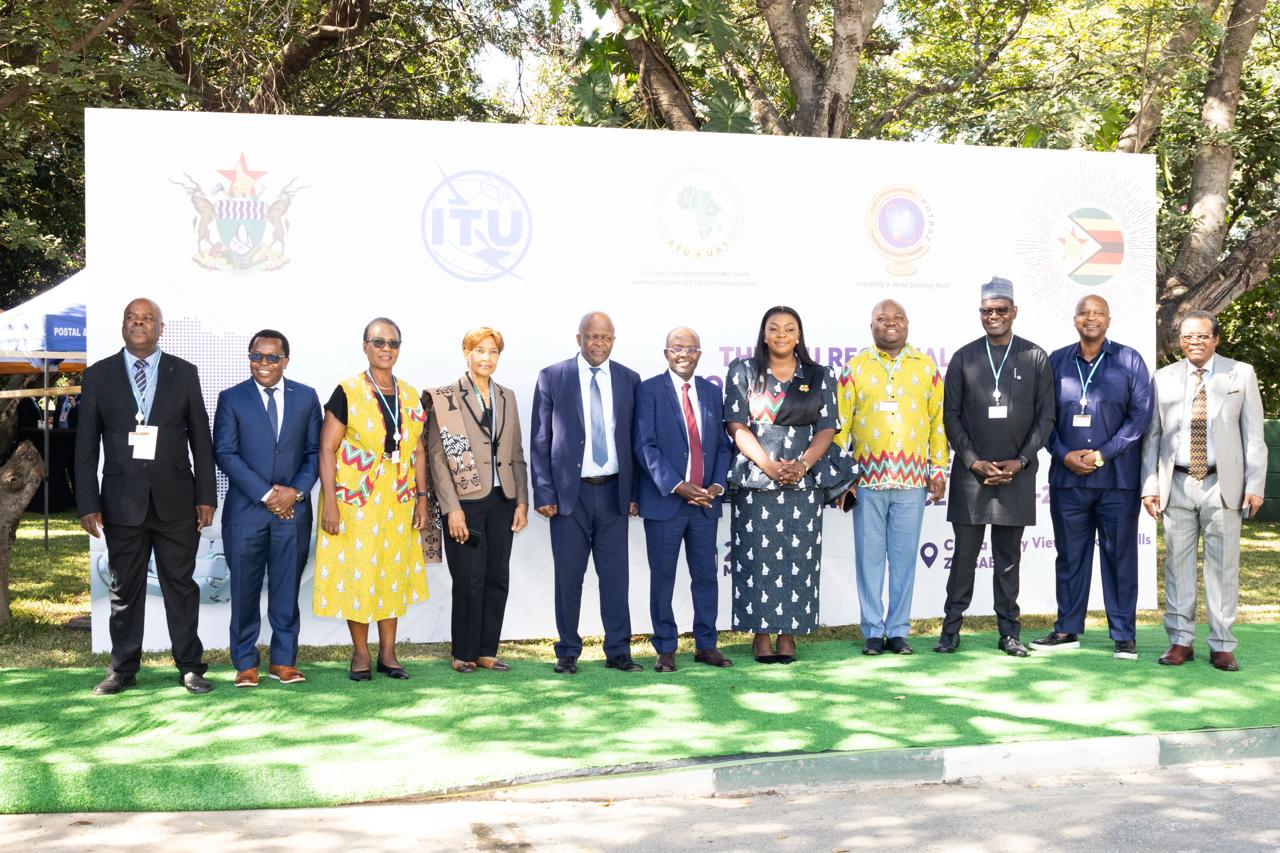
. . . Zimbabwe connects 8,000 schools by satellite as minister warns Africa against importing solutions
By Jonathan Mbiriyamveka
VICTORIA FALLS — While ministers across Africa have delivered countless speeches about the importance of connectivity, Zimbabwe’s ICT Minister stood before the continent on Monday and said: watch what we are doing, not just what we are saying.
Honourable Tatenda Anastacia Mavetera used her keynote address at the ITU Regional Development Forum for Africa 2026 to unveil Zimbabwe’s domestic digital transformation agenda — not as a boast, but as a living blueprint for what she called “home-grown” African solutions.
“Africa’s solutions will not be imported; they must be home-grown,” Minsiter Mavetera told delegates at the Cresta Sprayview Hotel in Victoria Falls. “In Zimbabwe, we have chosen not to wait.”
The Minister then detailed three major national initiatives that she argued demonstrate how a landlocked, developing nation can leverage technology to leapfrog traditional stages of development.
First, the Presidential Internet Scheme. Through this programme, the Zimbabwean government is connecting approximately 8,000 primary and secondary schools across the country via satellite technology.
“This is what a whole-of-government approach to meaningful connectivity looks like,” Minister Mavetera said. “No child in a rural classroom is left behind.”
The scale of the ambition is striking. Zimbabwe has approximately 9,000 primary and secondary schools nationwide. The Presidential Internet Scheme therefore aims to bring connectivity to nearly 90 percent of the country’s educational institutions, many of them in remote rural areas where fibre optic cable is not economically viable.
Second, the Minister announced that Zimbabwe is mobilising over $200 million to launch its own communications satellite.
“This is not about prestige,” Minister Mavetera emphasised. “It is about sovereignty and ensuring that every Zimbabwean has access to affordable, reliable connectivity on our terms.”
The satellite project, still in its fundraising and development phase, would give Zimbabwe independent control over a portion of its telecommunications infrastructure, reducing reliance on foreign-owned satellite operators and potentially generating revenue by leasing capacity to neighbouring countries.
Third, and perhaps most significantly, Zimbabwe launched its National Artificial Intelligence Strategy (2026–2030) in March 2026, anchored by an AI Acceleration Centre.
“Africa must be a creator of intelligent technologies, not just a market,” Minsiter Mavetera said.
The National AI Strategy establishes six foundational pillars for adopting machine learning and data analytics across key sectors.
The Minister highlighted concrete applications already underway: in agriculture, machine learning models predict commodity market prices while computer vision systems allow early detection of crop diseases; in mining, AI-enabled process optimisation enhances mineral traceability and reduces environmental damage; and in healthcare, predictive diagnostics are being rolled out to remote rural clinics.
“Geographic isolation no longer dictates the quality of medical attention,” Minister Mavetera said.
The Minister also noted that Zimbabwe is consolidating a harmonised National Data Centre because, in her words, “our data must be protected as a national asset.”
Taken together, these initiatives represent a significant investment by a middle-income country in its digital future. But Minister Mavetera was careful not to present Zimbabwe as a finished product or a flawless model.
“These actions are not merely national projects,” she said. “They are Zimbabwe’s investment in the African vision. We share our learnings, our challenges, and our successes, because Africa’s digital rise will be collective, or it will not be whole.”
The Minister’s remarks come at a moment when many African nations are reconsidering their dependence on foreign technology providers. From cloud computing infrastructure that stores African data on servers located in Europe or North America, to AI systems trained primarily on English-language data that do not understand African languages, the continent has long been a consumer rather than a creator of digital technologies.
Minister Mavetera argued that Zimbabwe’s approach offers an alternative path — not autarky or isolation, but strategic sovereignty.
The Forum’s theme — ‘Universal, meaningful and affordable connectivity for an inclusive and sustainable digital future’ — aligns directly with Zimbabwe’s domestic agenda. The country is also aligning its digital development with its National Development Strategy 2 (NDS 2, 2026–2030), the policy vehicle for achieving National Vision 2030: transforming Zimbabwe into “a prosperous and empowered upper-middle-income society.”
Whether Zimbabwe’s blueprint can be replicated across the continent remains an open question.
Different countries face different challenges: coastal nations with undersea cable access have different infrastructure needs than landlocked countries like Zimbabwe; large nations like the Democratic Republic of Congo face different governance challenges than smaller states.
But Minister Mavetera’s message to her fellow African ministers was clear: waiting for solutions to arrive from outside is no longer an acceptable strategy.
“Tomorrow belongs to the people who prepare for it today,” she said, closing her address. “We have no time to postpone.”
As delegates from across Africa return to their countries after the Forum, they carry with them not just speeches and resolutions, but a concrete example from Zimbabwe of what “walking the talk” actually looks like.
About Author