

By Jonathan Mbiriyamveka
Behind every successful health system is the infrastructure that supports it.
Zimbabwe is taking bold steps to strengthen its healthcare backbone, with UNDP and the Global Fund leading efforts to modernize facilities.
Warehouses and pharmacy stores have been built and renovated across the country, ensuring medications and medical supplies are stored safely and delivered efficiently to even the most remote areas.
The ripple effects of these improvements are already evident.

inside the NatPharm warehouse in Masvingo
Health workers like Farai Ncube, a pharmacist in Masvingo, say the upgrades have made their work easier and more reliable.
“We used to struggle with stock-outs and damaged medicines due to poor storage conditions,” he explains. “Now, we can deliver essential drugs with confidence.”
The UNDP commissioned the new NatPharm warehouse in Masvingo and 178 pharmacy stores marking a significant achievement in Zimbabwe’s healthcare infrastructure.
The project, supported by the Global Fund and UNDP in partnership with the Government of Zimbabwe, is part of the larger Resilient Systems Strengthening for Health (RSSH) initiative aimed at improving healthcare delivery across the country.
Speaking during a recent United Nations Communication Group (UNCG) Media Tour at the Natpharm Masvingo warehouse, Linda Chamboko, the General Manager said some 250 facilities in the province were being serviced.
“This is a state-of-the-art warehouse where we store and distribute medicines on behalf of the Ministry of Health and Child Care.
“We have the medicines for TB, and malaria, the ARVs, and the essential medicines that we store here. We used to have an old warehouse at Masvingo Provincial Hospital which was small and it was inadequate for the demands of the province,” Chamboko said.
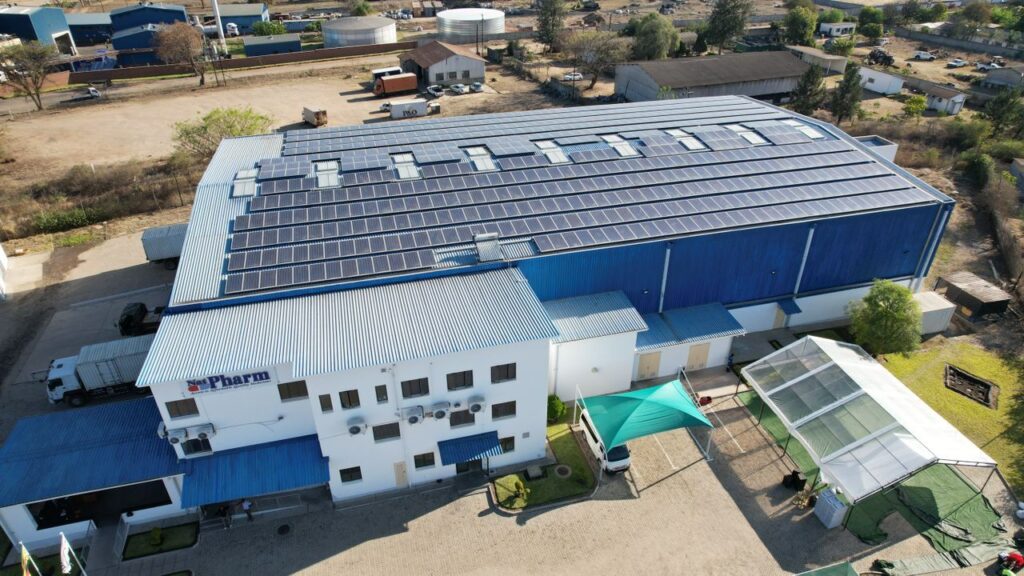
An aerial view of the solar pellets
The warehouse was constructed beginning in 2017 and it was finished around 2020.
Speaking during the commissioning of the Natpharm Warehouse UNDP Resident Representative in Zimbabwe, Dr Ayodele Odusola, said the warehouse, which cost $3.66 million, including the solarization that includes $322,000, provided opportunity for 24-7 electricity supply.
“And also, we are so happy about the 178 storage facilities in terms of the pharmacy stores across the country, of which we have handed over to government out of the 360 that we have constructed. But I just want to underscore the fact that the capacity of this warehouse is quite huge. It has 2,460 square meters in terms of size, and if you look at the pallets, it has 2,988 pallets, which is really huge,” Dr Odusola said.
“And we strongly believe this will help to really promote quality health standard in terms of medical products across the country. And we strongly believe it will help to really sustain what we call quality health chain management system. UNDP is really prioritizing this issue of national ownership of the facilities we are putting in place. We are also supporting sustainability of them, and I strongly believe that the government will be able to use this to benefit access to universal health in Zimbabwe.”
These advancements align with SDG 9 (Industry, Innovation, and Infrastructure) and SDG 3 (Good Health and Well-being).
By investing in robust systems, Zimbabwe is not only addressing immediate healthcare needs but also laying the groundwork for long-term resilience.
As the country progresses, calls for more such initiatives grow louder.
With continued international partnerships and local engagement, Zimbabwe is proving that building stronger foundations leads to healthier and more hopeful communities.

About Author

