

BY MICHELINA ANDREUCCI
With the light, powerful cars, designers were increasingly searching for ways to improve grip – the extent to which the car is able to transfer power from the engine to speed on the track. One line of development was the application of aerodynamic principles using aerofoils or ‘wings’.
If driver skill is excluded, the performance of a racing car is a function of three factors: the power created by the engine and transmission, the drag of the car moving through the air and the grip provided by the tyres and suspension system to allow the power to be applied to the track.
‘Wings’ on F1 cars enhanced grip by generating down force from forward motion, the opposite effect of the lift generated by an aircraft wing. Wings were quickly adopted in F1 with Lotus using front wings made from inverted helicopter blades at the Monaco Grand Prix on 26 May 1968. Both Ferrari and Brabham then introduced cars with rear aerofoils at the Belgian Grand Prix held at Spa-Franco champs on 9 June 1968. This innovation diffused quickly throughout the teams and by 22 September 1968, at the Canadian Grand Prix held at St Jovite, every car on the grid was using some form of ‘wing’.
The availability and low cost of the Ford DFV meant that F1 teams, like Ferrari and BRM, who were vertically integrated – building their own engines and gearboxes, were at a disadvantage. In response to the proposed regulation changes of 1966, Ferrari had developed their Flat-12 engine, originally designed by Mauro Forghieri as an aircraft engine.
This had 12 horizontally opposed cylinders creating a wide, flat power unit.
The late sixties were a difficult period for Ferrari, both financially and technologically. In 1969 it ‘merged’ with Italian automotive manufacturer Fiat. Fiat took a 50% stake in Ferrari which provided a huge injection of cash to support Ferrari’s research and development activities. This allowed for the construction of a private Grand Prix circuit at Fiorano, close to the SF factory at Maranello.
The technical team used this facility to engage in a period of intensive development focusing on the Flat-12 engine.
These increased resources and development time enabled Ferrari to leverage its way back to the top of F1, winning world championships in 1975, 1976 and 1977. Ferrari’s success led many of the Ford DFV teams to look to alternative sources of power and, in particular, to 12 cylinder engines. In 1975 Brabham reached an agreement with Alfa Romeo to supply a Flat-12 engine developed by engine specialist Carlo Chiti, who had formerly worked for Ferrari.
In contrast, two other constructors, Tyrrell and Lotus, retained the Ford DFV, but developed more radical chassis designs.
Tyrrell created a six-wheel car with four small wheels at the front designed to reduce drag and enhance grip at the front of the car. In contrast, Lotus undertook a longer-term project that was to emphatically establish the importance of aerodynamics for F1 performance.
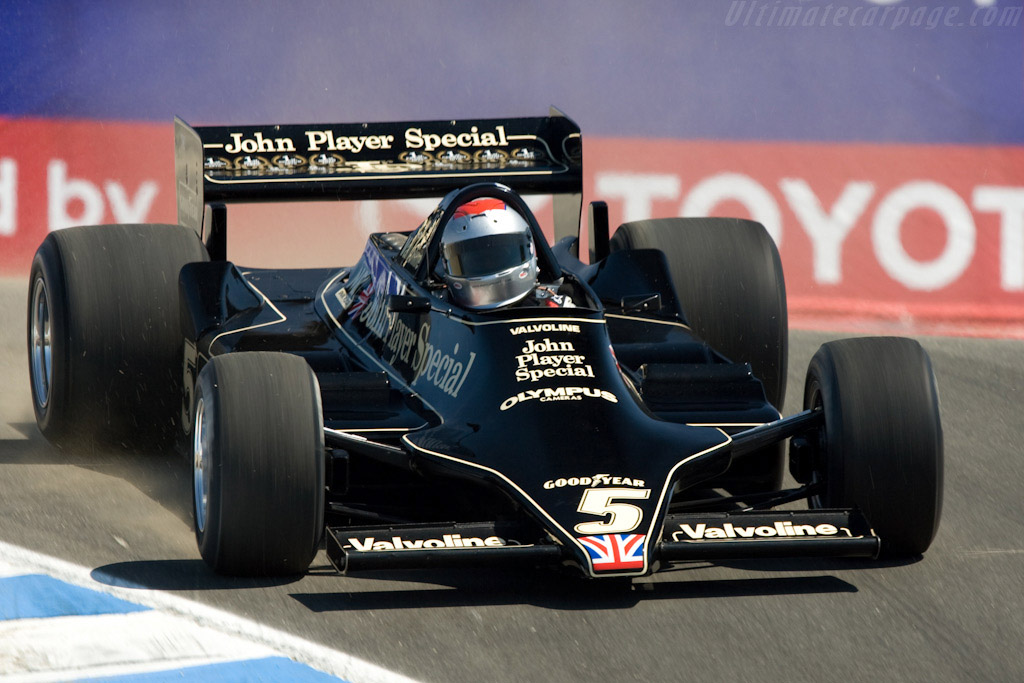
In 1974 the unusually poor performance of the Lotus team led owner Colin Chapman to ask Technical Director, Tony Rudd, to revisit the entire concept of a race car to see where performance gains could be made. Rudd, along with aerodynamicist, Peter Wright, explored the prospect of producing ground-effect in an F1 car. Ground-effect had been developed as a theoretical concept, but its practical application in F1 was unproven.
It was achieved by a breakthrough in using ‘skirts’ – i.e.: strips down the sides of the car that effectively sealed the under body area; and, as with many great discoveries, it came almost by accident. “. . . the [wind-tunnel] model was so decrepit we started getting variable results. It would be modified so often, it was made of card and plastic and clay and tape and what have you.
We got inconsistent results and we couldn’t figure out why and then I noticed that the side pods were sagging. We thought maybe it’s the gap at the edge [between the car and the ground], so we put some card down the edge in a little tiny gap and wumph! We couldn’t believe it! We had to re-do [the test] four times before we believed it.” Said Peter Wright, former Lotus aerodynamicist.
The Lotus design proved to be the most effective technological change in breaking Ferrari’s dominance of the mid-seventies. The Lotus 79 won the 1978 world championship establishing ground-effect technology as a dominant concept in F1 and many constructors subsequently attempted to imitate the design.
Since the majority of constructors used the same engine configuration as Lotus [Ford DFV], their imitations focused on design of the chassis.
Ferrari’s commitment to a Flat-12 engine however, meant that it was unable to create the narrow chassis profile needed to locate the ground-effect venturi (aerodynamically shaped tunnels which created the low-pressure area needed for ground-effect) on either side of the engine. The same problem also applied to Brabham which had shifted to the Alfa Romeo Flat-12 in1976. In contrast the narrow Ford V8 was ideally suited to this application.
This problem prompted Brabham’s Technical Director to position a large fan at the rear of the car in an attempt to create artificial ground-effect by sucking the air from underneath the car.
The Brabham BT46B ‘fan-car’ was a product of this innovative period and won the Swedish Grand Prix in 1978. Ultimately, it was banned because it was deemed to be outside of the regulations and due to the potential danger of debris being sucked through the fan and hitting following cars.
Dr.Michelina Andreucci is a Zimbabwean-Italian researcher and a published author in her field. For Comments E-mail: linamanucci@gmail.com
About Author

