

By Pylaia Chembe
Just a year ago, the land where Pikinini Jawanda Irrigation Scheme now thrives was a thicket, an area where the community hunted rabbits and birds to feed their families.
Fast forward one year, that very site has been transformed into a model of climate-proofed, self-reliant agriculture.
According to local oral history, the idea of establishing an irrigation scheme—an organised, community-run farming system using controlled water supply, was first mooted shortly after the construction of Manyuchi Dam in 1985.
However, due to limited resources and competing priorities for nearly four decades, the vision remained just that- a vision.
That long-standing dream only began to take shape when the Government of Zimbabwe, in partnership with the Green Climate Fund (GCF) and the United Nations Development Programme (UNDP), launched the Climate Resilient Livelihoods (CRL) Project.

With an investment of nearly USD 1.1 million, the project facilitated the development of a 156-hectare irrigation scheme, roughly the size of 230 standard soccer fields.
A critical feature of the scheme’s climate-proofing infrastructure is the floating pontoon abstraction system installed in the Manyuchi River.
Unlike conventional systems, where pumps are fixed on the riverbank, this innovative raft-mounted system adjusts with water levels, ensuring a reliable water supply even during dry periods, allowing farmers to irrigate crops to maturity and maintain food security.
Water efficiency has also been prioritised.
While traditional systems often rely on flood irrigation, wasteful and unsustainable in dry climates, Pikinini Jawanda uses centre pivot systems to irrigate over 40% of the land, with the remainder covered by semi-portable sprinklers.
These modern systems provide better water control and reduce wastage, ensuring sustainable use of available water.
Supporting infrastructure has also been put in place, including a switch room, a 1 km power main line, and approximately 9,000 metres of irrigation pipeline. These investments have laid a solid foundation for sustainable, climate-resilient agriculture in the region.
What sets Pikinini Jawanda apart, however, is not just the infrastructure but the extraordinary ownership and commitment shown by its 300 beneficiary farmers. Recognising the opportunity, they took initiative early on.
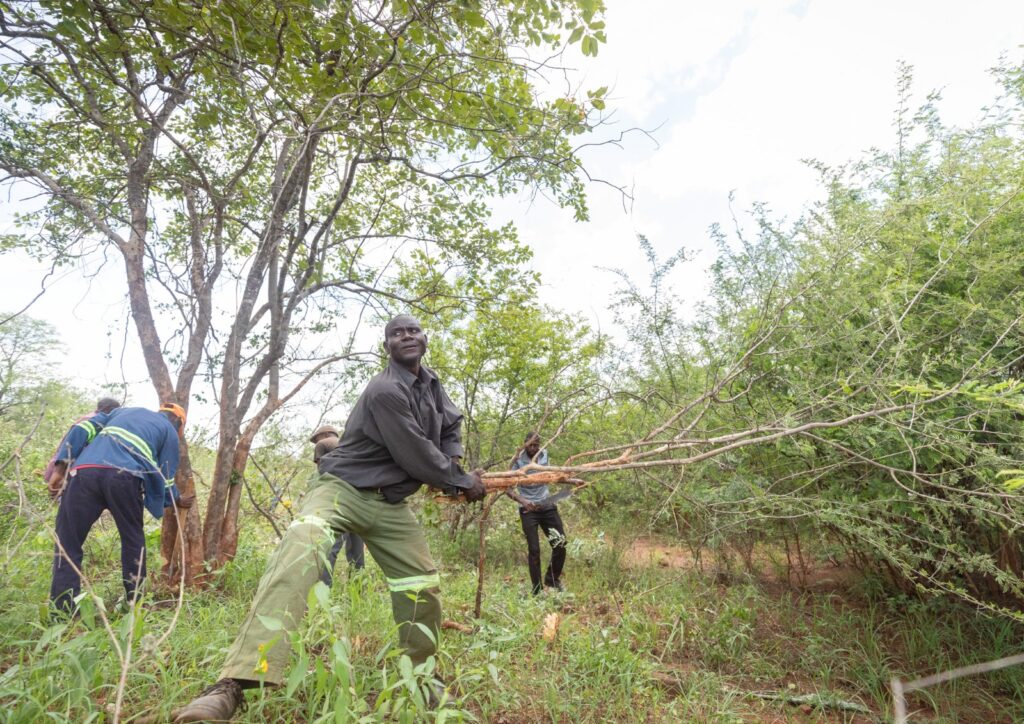
“We were not going to just sit and wait for the project to do everything for us. Even before the equipment was set up, we began clearing the land ourselves. Even though we did not have much, this was our way of contributing to our community’s development,” said Mr. Chizivano Shava, Chairperson of the Irrigation Management Committee (IMC).
Each beneficiary contributed up to 45 days of rotational labour to clear the land, a collective effort valued at approximately USD 54,000, based on Zimbabwe National Employment Council Agriculture Rates.
“Everyone had a role,” said Mr Shava. “The young cut down large trees, while older women and men followed behind clearing the land.”
Farmers are also playing a key role in fencing the scheme. They have already secured half of the required 6.3 km of fencing, with the remaining section temporarily covered using tree branches.
These early efforts enabled production to begin without delay.
Under the guidance of Agricultural Extension Officer Mr. Jonah Bukuvani, Pikinini Jawanda has evolved from a survival hunting ground into productive farmland.
Currently, nearly 50% of the scheme is under cultivation, with crops like maize grown for household consumption and fresh market sales.
From just a small portion of land, farmers harvested 19 tonnes of grain for household consumption and earned nearly USD 4,000 in sales, which is being reinvested into the scheme.
The scheme has also secured a contract with a private seed company to produce sugar bean seed—providing a guaranteed market for the farmers.
“Pikinini Jawanda beneficiaries are easy to work with because there is inclusive planning, and all decisions are publicly endorsed. This has really helped us avoid conflict,” said Mr Bukuvani.
Farmers also received several trainings that have empowered them to run the scheme efficiently. They have benefited from critical trainings provided by the project, including leadership and governance, Operation & Maintenance (O&M), farming as a business, water management, costing and financial literacy etc.
“I’m grateful for the trainings, they’ve added real value to what we do,” said Mr Bukuvani. “My role is now to keep reinforcing those lessons internally.”
Looking to the future, the scheme is taking bold steps toward sustainability. To reduce reliance on individual contributions, the IMC has designated 5 hectares of land to grow crops specifically to finance O&M.
Security is also well-coordinated, with a gender-sensitive community rotation system, women guard the fields during the day, and men at night, ensuring the safety of both crops and infrastructure.
During a recent visit, Professor Obert Jiri, Permanent Secretary in the Ministry of Lands, Agriculture, Fisheries, Water and Rural Development, commended the community.
“The progress at Pikinini Jawanda is commendable, especially the community’s ownership and commitment. But to grow into a viable agribusiness, farmers need more than infrastructure. Access to affordable credit, mechanisation, and value chain knowledge is essential. Institutions like AFC must come on board to support this transformation,” said Prof. Jiri.
Likewise, UNDP Zimbabwe Resident Representative, Dr. Ayodele Odusola has expressed appreciation and support to government initiatives.
“The sense of ownership shown by farmers at Pikinini Jawanda is commendable. Their commitment is a seed for long term sustainability even after the project’s completion. This is what community-driven agriculture should look like,” said Dr Odusola.
Dr Odusola reaffirmed UNDP’s commitment to work with the Government of Zimbabwe to replicating this successful model to other irrigation schemes in Zimbabwe to enhance national food security.
While the progress has been remarkable, there remains room for growth. For example, acquiring the scheme’s own mechanised equipment could reduce dependency on hired services and open an additional income stream.
Ultimately, the spirit of innovation, resilience, and collective action demonstrated by the farmers at Pikinini Jawanda is a key ingredient for viable irrigation systems.
As government institutions, development partners, and financial institutions work to sustain and scale up such models, Pikinini Jawanda stands as practical demonstration that when supported, rural communities can lead their own transformation toward climate adaptation, food security, and economic empowerment.
About Author

