

By Dr Tony M Monda
Although Zimbabwean art has had prodigious ebb and flow of generations of visual artists, styles, fortunes and social patterns, very few have tackled social criticism.
As such in comparison to music and literature, social criticism has never been a popular theme in the visual arts in Zimbabwe as has been the case with post-independence Zimbabwean literature – exemplary in the works of Dambudzo Marechera, Shimmer Chinodya, Petinah Gapa and Yvonne Vera, relevant from the mid-1980s to post-2000.
Bridging this divide is an oeuvre of mixed media and collage paintings (using l’art trouve/found objects), presented by a new signature in the visual arts of Zimbabwe – O’Neal Tanaka Maisiri, just as the visual cultural wave in Zimbabwe was ebbing due to the lack of impetus from the relevant art and cultural institutions since 2000. Emerging of his own volition, O’Neal Maisiri‘s solo exhibition entitled “I Wish You Could See Me Now”, interrogates the social realities of the youthful and ostentatious urban middle class society in Zimbabwe today.
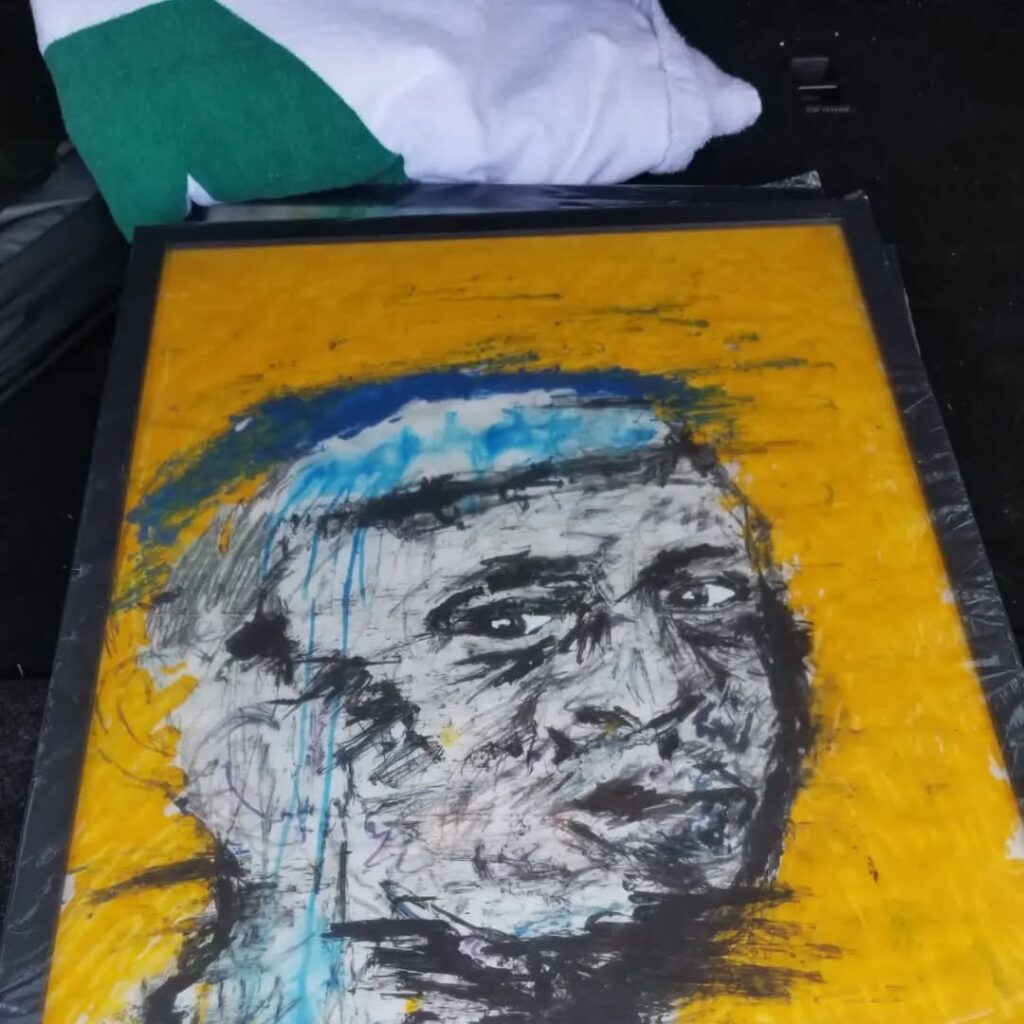
In a context straddling contemporary internationalism and Zimbabwean content and ideology, Maisiri presents a spontaneous colourful outpouring of ideas in paint that reads as a social analysis of a young urban demography.
As a social critic Maisiri makes a penetrating statement about the vanities and false identities paraded by the misdirected youth of today. His art stems from an exhaustive study of life of the middle- and- upper- class youths on the margins of society.
Born in Harare on 9 April, 1998, the Zimbabwean artist and illustrator O’Neal Tanaka Maisiri received his early art education at St. John’s Emerald Hill High School in Harare, where he attained upper 6 Zimsec Art. This was followed by further art studies at August Studio Artist’s Fellowship (2020), and The Herb Farm (2019), in South Africa and at various art studios in Harare. Dedicated practice, experience, raw talent and guided scholarship distinguish his art from his peers.
Inspired by modern poetry, pop culture, graffiti, hip hop, Christianity and apocalyptic revelations in the Bible that harkens the end times for mankind, he interrogates the social dilemmas faced by Zimbabwean youths.
In a flowing continuous movement of paint and colour, at 26, Maisiri’s artworks expose the futility of materialism in our digital world filled with deceit, broken dreams and unattainable illusions.
According to the artist – “Vanhu vakuraramira Pfuma”—people now live for wealth; as though money and inheritance are the ultimate goals of existence… It’s fool’s gold—a glittering illusion of success that leaves individuals disoriented in an ever-expanding search for an identity in a global village….
Yet, in pursuit of a false persona, people trade even the irreplaceable—their dignity, family, or even their own bodies”.
An extremely talented new signature, Maisiri is an autodidactic visual artist whose visual inventiveness exposes the currents of thoughts and deeds that occupy the minds of today’s urban middle class youth beset with growing pains living in an indifferent socio-economic environment.
Alive with meaning, his satirical pictorial narratives are inspired by his microscopic view of his peers’ urban lifestyles.
Expressionist in style and spontaneous in execution, using linguistic witticism his paintings are laden with graffiti announcing unattainable ideals and questions of existentialism. His is a parody of the futile vanity of today’s generation blindly following fashion and its attendant branding to find an identity.
Designer labels, fake or original, become transient status symbols that soon wear out. Images of several designer brands such as La Coste, Nike, Nike Air, Puma, Fubu, Converse, and Timberlands are coveted trappings for the youth today.
Gender sensitive, Maisiri interrogates social norms and etiquette, pitting Western ideals and with traditional Shona cultural norms. He questions the futility and transience of those Western social traits inherited by African people.
His figurative and analytical artworks question our current existence, our disparate Zimbabwean identities and interrogate our aspirations for the future. His insight into the foibles of human nature is illuminating.
Animated with gesture, Maisiri’s colourful palette and enquiring concepts are a repository of
knowledge that defines today’s urban youth who are greatly inspired by the digital age of Starlink, Tik-tok, Twitter, X, Facebook and other global digital platforms. Making sense of the new social media-influenced behaviour of the privileged northern urban Harare youths is a daunting task to which Maisiri responds with colour, satire, spontaneity and resource.
His art represents the making of a new age genre of post-independence social commentary.
Whilst the colourful context may elude the layman, the lavish staging and posturing of the nouveaux riche in his paintings is clearly that of a rudderless young society obsessed with their false image of themselves. The Zimbabwean artist sees it as his mission and duty to document the excesses of this new generation swallowed up in the fake world of social media and designer labels.
In the theatre of urban life in Harare, Maisiri’s paintings foray into the otherwise hidden and impenetrable labyrinths of thoughts, dreams and aspirations of young rich Zimbabweans who have too much, exemplified in his work ”SSS”.
Executed in swirls of orange, blues, pink, purple and green – flashy, modern and vintage cars are set bumper-to-bumper in a show of opulence. The artwork is based on urban materialism and class differences.
The use of plastic is a visual and pictorial ridicule of the rich and transient qualities – symbolising the artificialness of today’s nouveaux riche in a society where unemployment figures exceed 85%.
The artist employs spontaneity, visualisation and random thoughts in a painterly automatism to express his musings, concepts and opinions of his peer generation.
Free from prescriptive, discursive and aesthetic strategies and agendas, Maisiri’s narrative expresses his ‘raw art’ with a keen bird’seye view and finely honed ideology. His is a dramatised reality of reality.
In the vein of Brett Easton Ellis’s ‘Less Than Zero’ and F. Scott Fitzgerald’s ‘The Great Gatsby’ and artist Jean Michel Basquiat, Maisiri casts his sardonic eye on his own generation. The real understanding of his art lies at the core of his subconscious musings where spontaneity, random thought and painterly automatism vividly express his concepts.
There is a sense of tactility and serendipity found in the raw materiality and in his use of random object trouve recovered from the streets of the capital and pasted onto his works. This ingenious technique critically reads as an adjunct poetic component to his idea of the random waste that is characteristic of this generation.
As a sensitive artist Maisiri reveals his awareness of the aesthetic, textural and chromatic values of paint and the function of their secondary meanings as vehicles of communication.
For instance his work entitled ‘Avant-garde’ shows how the new generation views their world through rose-tinted glasses. Here, four figures occupy a peach background in an assemblage that includes embroidery, collage, buttons, weaves and actual sunglasses.
The title ‘Avant-garde’ refers to a new urban sub-tribe of youths who spend their empty pseudo lives in a capsule of pretence.
This urban generation appear directionless, empty and uninspired yet obsessed with their own sense of self-importance; not unlike Les Sapuers of the DRC in the mid-1990s.
In an unusual palette of peach, pink, orange, blue, gold, purple and white, he highlights the cosmetic and pretentious nature of the characters in his work.
Similarly, the works ‘Capping Vanities, ‘Cloud Headed’, ‘Hands on the Table’ and ‘Lying on the Table’, etc., are a social critic on his youthful generation overwhelmed by materialism, vanity and futility.
His epic paintings, based on urban materialism and class differences, expose both genders replete with popular Zimbabwean slang, urban symbolism expose the material trappings coveted by today’s Zimbabwean youth. Again, the use of plastic is a visual and pictorial ridicule of the rich and transient qualities – symbolising the artificialness of the nouveaux riche society.
His artworks bring to his viewers an up-beat, zany, modern Zimbabwean urbanism – perhaps a new genre of visual art for a new generation of corporate collectors.
Dedicated to his late mother, most of Maisiri’s his paintings are strikingly large suitable for museum and corporate collections. They expose the futility of materialism in our digital world filled with deceit, broken homes, broken dreams and unattainable expectations. The exhibition runs until the New Year 2025
About the author
Dr. Tony Michel Monda holds a PhD. in Art Theory and Philosophy and a DBA in Post-Colonial Heritage Studies. He is an international art critic, curator, visual artist, humanities researcher and historian. Tony Michel Zvimba Monda is the first American and British trained indigenous Zimbabwean visual artist, curator and art critic-lecturer since 1992. Monda is also an accomplished and prominent sculptor, ceramicist, graphic artist, photographer, musician, dancer, actor, poet, novelist, analyst, historian, adjudicator and lecturer in the arts, architecture, archaeology, humanities and African cultural values.A privileged interlocutor for African artists’ interests around the world, he has contributed extensively to the education of Zimbabwean artists. He is omnipresent on the Zimbabwean arts and cultural scene and has a national voice in decisions relating to the management, administration, documentation, education and policy formulation of art and cultural matters in Zimbabwe. Monda is the founding president of the Zimbabwean section of L’Association des Critiques d’Art – AICA, Paris. He represented Zimbabwe in his capacity at various international art conventions in Europe, Asia, Africa and the United States. Amongst the most important symposia was the Africa ’95 World Art Critic’s Conference – where he represented his nation Zimbabwe, and continues to do so for select global art and humanities conventions.
E-mail: tonym.MONDA@gmail.com – tonymichelmonda93@gmail.com/ chikodmak@gmail.com
About Author

