

By Sirak Gebrehiwot
With the 2030 deadline for the Sustainable Development Goals (SDGs) drawing near, Zimbabwe is accelerating its efforts through innovative, human-focused, and environmentally sustainable programmes.
A recent high-level joint SDGs Steering Committee meeting, held on 12 November 2025, underscored the nation’s commitment to translating aspirations into tangible results.
The meeting, co-chaired by Deputy Chief Secretary to President and Cabinet Mr. Churu, representing the Chief Secretary to the President and Cabinet, Dr. Martin Rushwaya, and UN Resident and Humanitarian Coordinator Mr. Edward Kallon, convened over 100 stakeholders from government, civil society, academia, development partners, and the private sector.
Discussions centered on evaluating progress under the National Development Strategy 2021–2025 (NDS1), drawing key lessons, and planning the course for NDS2 (2026–2030).
Dr. Rushwaya, in his opening remarks, highlighted Zimbabwe’s milestones, including the launch of the Open SDGs Data Portal, a pivotal step in promoting transparency and citizen engagement and showcasing the nation’s leadership in data revolution endeavors.
He reaffirmed the government’s vision of becoming upper middle-income society, aligning with the global 2030 Agenda for Sustainable Development and the Africa Union Agenda 2063.
Zimbabwe’s programmes demonstrate a strong dedication to both people’s well-being, economic transformation and environmental stewardship. Community-level progress is apparent in several key areas:
* Health and Social Protection: Notable progress includes a decline in maternal mortality rates, improved life expectancy, and the implementation of new digital social protection platforms reaching vulnerable populations.
* Education and Youth Engagement: Over a dozen SDGs Schools Proposal Writing Competitions are fostering youth participation, cultivating a new generation ready to drive sustainable development.
* Environmental Resilience: Prioritizing climate-smart agriculture, renewable energy, and sustainable land use, Zimbabwe’s initiatives include scaling mini-grids, solar home systems, and supporting rural electrification, all aimed at promoting equitable access to clean energy.
UN Resident and Humanitarian Coordinator Mr. Kallon emphasized the importance of these human-centered strategies, asserting that the collective task is to turn strategy into rapid, visible, and inclusive results for all Zimbabweans, especially marginalized groups.
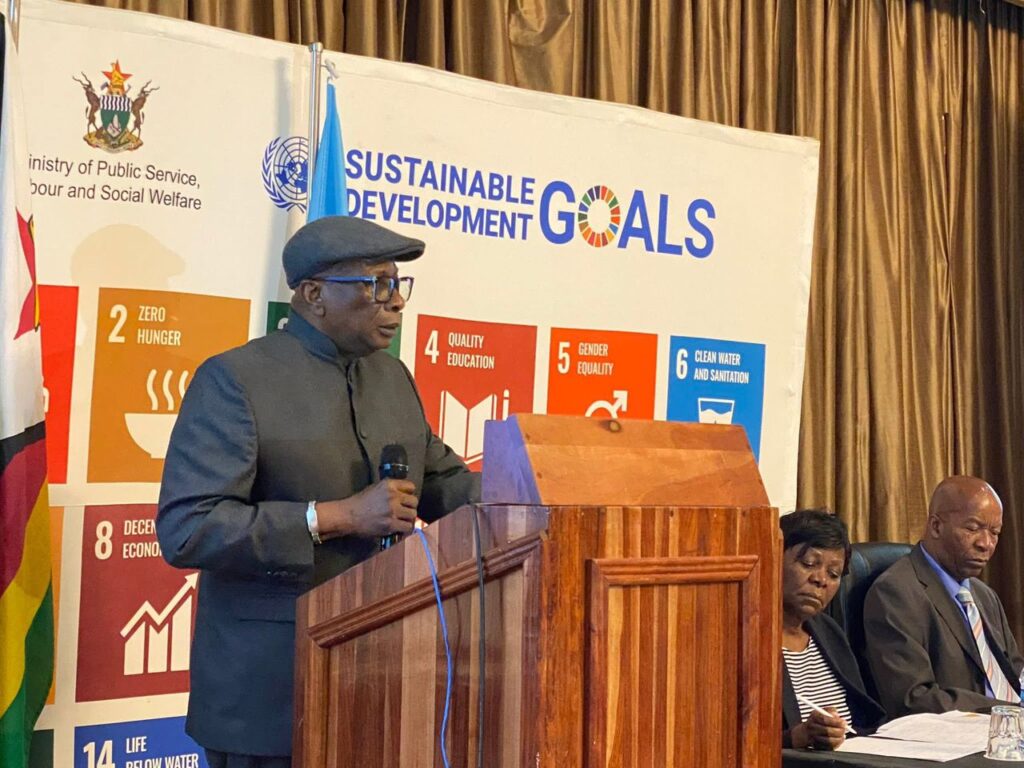
Mr Edward Kallon
The Joint SDGs Steering Committee deliberations also focused on accelerating economic transformation through the Six Transitions—energy, digital, education, land systems, jobs and social protection, climate action and resilience building—all linked to sustainable, human-centered development.
Profitable and environmentally conscious investments, such as renewable energy projects and digital infrastructure, are seen as crucial for job creation and improved livelihoods.
Mr. Kallon also noted that aligning financing and social contracts with global frameworks like the Pact for the Future and the Sevilla Compact on financing for development, and the recent Doha Declaration on Social development is key to unlocking investments needed for a greener, more equitable Zimbabwe.
Despite notable progress, challenges such as climate shocks, debt overhang, and data gaps remain.
The meeting highlighted the urgent need to resolve debt and arrears through the High-Level Structured Dialogue, which focuses on economic reform, governance, and land tenure.
Fiscal management reforms, anti-corruption measures, and inclusive land policies are vital for rebuilding investor confidence and ensuring that no community is left behind.
The Joint SDGs Steering Committee Meeting reaffirmed the importance of bolstering partnerships among government, UN agencies, development partners, and civil society. The creation of a national SDG monitoring dashboard and investment prospectus aims to translate commitments into measurable results, fostering transparency and accountability.
Mr. Kallon articulated the UN’s unwavering support, underscoring the importance of a collective will rooted in political commitment, fiscal discipline, enhanced macro-economic stability and inclusive policies.
He stressed that by harnessing regional integration under the SADC, COMESA, and Africa Continental Free Trade Area, fostering innovative finance, and prioritizing human and environmental needs, Zimbabwe can decisively accelerate its journey to SDG achievement.
Moreover, investments should focus on strengthening statistical capacity, enabling the collection of timely, disaggregated, and interoperable data across key areas like poverty, employment, gender, and the environment.
This data will be essential for guiding evidence-based adjustments and ensuring accountability in sustainable development efforts.
Developing a comprehensive national SDGs acceleration plan that aligns with the priorities, milestones, and outcomes outlined in the NDS-II is crucial for making the period from 2026 to 2030 a decisive phase.
Demonstrable gains can be realized through expanded public infrastructure including electricity access, improved quality social services in targeted districts, food and nutrition security, and speeding up the national digital social protection registration accompanied by coverage.
Furthermore, restoring sustainable access to concessional finance and capital markets on improved terms is vital.
These efforts should collectively lead to substantial poverty reduction, enhanced food security, and measurable advancements on SDG targets.
In terms of policy priorities, scaling up targeted, country-led investments that aim to lift people out of poverty by strengthening essential systems such as food security, universal health coverage, water and sanitation, adequate housing, energy access, and quality education are critical.
Mainstreaming climate adaptation and mitigation into sector planning is equally important, ensuring that the NDS II climate targets are supported by investment-ready projects in renewables, climate-resilient agriculture, water security, and nature-based solutions with the adoption of anticipatory action plan, early warning systems and crisis modifiers when natural disaster strikes.
Mobilizing finance and technology partnerships within the NDS-II and the UN Sustainable Development Cooperation Framework will be crucial for supporting a just transition, alongside international advocacy for predictable climate finance, robust adaptation funding, and mechanisms to address loss and damage.
Promoting employment in green, digital, and care economies through public–private partnerships, local value addition, and policies that incentivize formalization and inclusive private investment can create new job opportunities.
Investment in lifelong learning, technical and vocational education and training (TVET), digital skills—including AI literacy—is necessary to enable youth and workers to transition into productive, decent employment.
Women’s economic empowerment, labour protections, living wages, and workplace safety should be prioritized across employment strategies to foster equitable growth.
Aligned with the SDGs and rooted in the respect for human rights and inclusion, policies must explicitly reach marginalized groups such as women, youth, persons with disabilities, older persons, Indigenous peoples, migrants, and other vulnerable communities.
These policies should be supported by measurable targets and accountability mechanisms to ensure progress and inclusivity.
The Government has ensured that gender equality stands as a priority pillar and mainstreamed across all NDS II priority areas, aiming to eliminate gender-based violence, close economic and digital gaps, and ensure that technology and AI policies are designed to prevent discrimination.
Leveraging multistakeholder partnerships—including UN agencies, development partners, academia, and communities—can mobilize necessary resources such as finance, technology, and capacity-building efforts.
Such collaborations should be characterized by predictable, results-based cooperation supported by robust monitoring, evaluation, and learning systems to demonstrate impact and enable rapid adaptation.
It is through a collective will and practical solidarity that Zimbabwe can achieve the SDGs within the next five years.
The United Nations is committed to supporting Zimbabwe in these efforts by mobilizing expertise, brokering effective partnerships, and ensuring that financing and policy solutions are coherent, socially just, and environmentally sustainable.
As Zimbabwe advances toward 2030, the focus remains on scaling up human-centered and environmentally-responsive national flagship programmes, ensuring progress that benefits all sectors of society, particularly the most vulnerable.
With renewed commitment and strategic partnerships, the next five years will be decisive in turning Zimbabwe’s development ambitions into a sustainable reality for its people.
Sirak Gebrehiwot is UN Partnerships and Development Finance Advisor at the UN Resident Coordinator’s Office.
About Author

