

BY DR TONY M MONDA
It began with Zimbabwean Shona sculpture shortly after independence when a handful of African-American celebrities visiting Zimbabwe were captivated by what was then known as ‘Shona Stone Sculpture’. Cecily Tyson, Miles Davis, Danny Glover, Denzel Washington, were amongst the initial Art collectors that started the ball rolling.
Today, outstanding Zimbabwean visual artist Moffat Takadiwa is producing thought–provoking tapestries of found objects that are mesmerizing a new generation of African-American art collectors and celebrities including Jay-Z and Beyonce, Kevin Hart and others.
Raised in a remote rural communal farming area known as Tengwe, in the Mashonaland West Province of the country, Takadiwa is a Zimbabwean visual artist who ingeniously converts medical, commercial and manufacturing refuse into astounding works of art, and who will soon be counted amongst the Blue–Chip artists from Africa.
Now Mbare-based, the mid-career professional artist was born in 1983. Following high school, Takadiwa studied Fine Art at the Harare Polytechnic in 2006, at a time when Zimbabwe was
experiencing economic hardships and material resources and conventional art supplies were limited or out of reach for most artists.

Innovation, experimentation and foraging for found objects and random joinery materials became the only way artists like Takadiwa could produce expressive and telling works of art. Fortuitously, serendipity has a way of reflecting the order and disorder in society and very often, original socio-cultural concepts and deeper meanings can be found in what a consumerist society discards.
Globally, industry and commerce have left an ugly footprint on the environment; with the advent of COVID-19, the medical industry has increased its toxic waste on the environment, particularly in Africa.
This phenomenon impelled Takadiwa, a new-age philosopher, social commentator and environmental conservationist, to produce his now globally renowned conceptual tapestries of colourful recycled materials. Despite our inherent capitalist modernity, found objects for L’art
Trouve, are an integral part of Takadiwa’s artistic output. Today his work is embedded in the socio-cultural, historical and socio-political issues affecting ordinary Zimbabweans.
According to Takadiwa, “ . . . everyday objects and refuse which were often neglected by society become a medium of communication and expression for me.”
Amongst the miscellany of industrial, commercial and medical waste he sweeps up, carefully selects and sorts out thematically and aesthetically before sterilising them are: ball pens, toothbrushes and toothpaste tubes, typewriter ribbons and keys, computer waste, aerosol cans, plastic bottle tops, spray bottles, and more.
For the artist every scrap of debris and cast away-object has potential to produce thought-provoking tapestries that reveal his artistic ingenuity.
Discarded post-COVID-19 vaccine injection vials, disposable syringes and disposable masks are a witness of the recent era of COVID-19.
Takadiwa’s art works made from disposed medical accessories reveal their inherent qualities of ineffective disposability and the permanence of these objects, further revealing the inner fragility of today’s material society and the environment.
The astute visual artist weaves together a vast quantity of these used and discarded materials and machinery to create his large-scale sculptural pieces. Small, everyday objects are woven together to make impressive organic forms evocative of African ethnic jewel-encrusted tapestries in ritualistic and ceremonial simplicity.
The artist’s choice of materials communicates his concern with issues around consumerism, inequality, post-colonialism and the environment.
Working as a public health communicator and medical epidemiologist, I was greatly impressed by Takadiwa’s innovative and environmentally conscious conceptualisation. His art work can be read as a provocation and inquiry into current pertinent civic and public health issues. Most noticeably, Zimbabwe’s lax civic laws on refuse dumping and the Harare City Council’s disregard for sanitisation, as well as the negative effects of Western consumerism on Africa’s environment, especially in these times fraught with the threat of new pandemics.
Meshed together in huge installations are telling statements of high-density suburban life in the periphery of Harare.
There are overtones in his work of neglected urban environmental health systems, neglected hygiene, desanitisation and slipshod public health disease control. His woven installations also critique the health institutions and medical industries post-COVID-19 impact on the environment.
Concurrently, Takadiwa’s tapestries of found objects contain several layers of meaning. There are aspects of his work outlining the unspoken power of Western consumerism and its effects on existing healthcare systems in their former colonies in Africa.
Using found objects that are constructed, woven, threaded and bonded, Takadiwa produces works that are conceptually and technically ingenious. They call into question, reconfigure and reconstitute the original identity and functions of the found objects.
Latticed and bagged silhouettes portray biomorphic beings and animals constructed from the left-over miscellany of industrial production, Takadiwa’s l’art trouve are monumental in size and thematically well resolved. The installations are concurrently a reflection of the dynamism of technology and industry in Zimbabwe as well as a warning on the dangers of neglected waste management in the country.
Over the years, Moffat Takadiwa has become an important figure in Zimbabwe’s contemporary art milieu.
He has participated in numerous group exhibitions and won numerous art competitions since his graduation from Harare Polytechnic College in 2008. He exhibited at Harare’s Delta Gallery in the year 2008, the Joburg Fringe and the Berlin Art Fair in Germany in 2012; which gave him a better understanding of the international visual art scene.
As a career artist, Takadiwa served as director- curator of First Floor Gallery, an artist run gallery based in Karigamombe Centre, in Harare, from 2010-2014, where he held his first solo exhibition in 2012. That same year he exhibited in Bangkok, Thailand, where he made his first breakthrough sale.
In 2014 Moffat Takadiwa signed his first international deal with Tyburn Gallery and collaborated with Whatiftheworld Gallery in Cape Town, South Africa. Although Takadiwa has exhibited extensively in various prestigious galleries around the world, his career excelled in 2016 when he partnered with Nicodim Gallery in Los Angeles, USA. Here, many African-American celebrities based in the West Coast began to collect his work with superstars such as jay- Z and Beyoncé now listed as some of his patrons, whilst top-flight American architects and designers recommend his work to their clients.
Takadiwa has exhibited extensively around the globe. His recent notable exhibitions include A Love Letter to LA, curated by Storm Ascher, at Superposition Gallery, Phillips Auction House, Los Angeles (2023); Feeling Without Touching, Nicodim, New York (2023); Zero Zero, Semiose, Paris (2023), Nous sommes tous des Lichens, Musée d’art Contemporaine de la Haute-Vienne at château de Rochechouart (2022); The Bull (solo), Semiose, Paris (2022); Brutalized Language(solo), Nicodim,
New York (2022); Witch Craft: Rethinking Power(solo), Craft Contemporary, Los Angeles (2021); This is Not Africa: Unlearn What You Have Learned, ARoS Museum, Denmark (2021); Mr. Foreman you have Destroyed the Farm (solo), Semiose, Paris, France (2021); INXS: Never Before Seen Major Works by Simphiwe Ndzube, Moffat Takadiwa, Zhou Yilun, Nicodim, Los Angeles, CA (2020); Son of the Soil (solo), Nicodim, Los Angeles, CA (2019); Thread., Long Beach Museum of Art, Long Beach (2019); Material Insanity, Museum of African Contemporary Art Al Maaden, Marrakech (2019); The Eye Sees Not Itself, Nicodim, Los Angeles (2018); and the critical Chinafrika – Under Construction, at the Museum for Contemporary Art in Leipzig, Austria (2017).He has further exhibited at the Tyburn Gallery in London and the Gallery Vigo in London which was one of the first international galleries to support his work and was the first to show his Assemblage sculptures constructed from discarded computer keys.
Earlier this year Moffat Takadiwa presented his “Vestiges of Colonialism” exhibition at the National Art Gallery of Zimbabwe in Harare, his first solo exhibition in Zimbabwe in over a decade.
The works on show featured art made from recycled materials reflecting on life in Zimbabwe and the colonial residues which are still apparent in the independent southern African State today.
Currently Takadiwa’s work features in various international collections in museums, city collections, art galleries, and private collections, from Ghana to Saudi Arabia, to America and Europe. His work has attracted global attention solidifying his status on the international contemporary art scene.
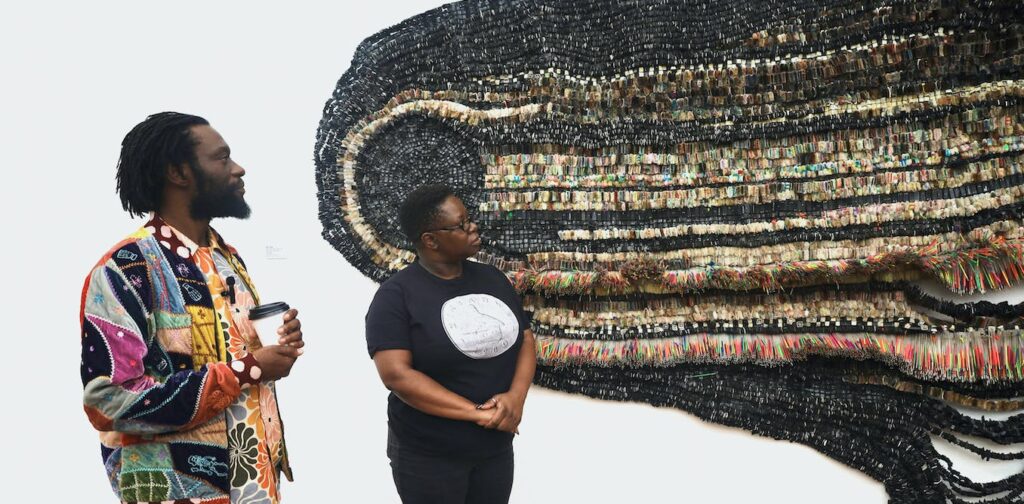
Mbare-based, Moffat Takadiwa, who was one of the founder members of Mbare Art Space, a
former beer hall in Harare, which now provides resources and mentorship to young artists, remains humble and still finds time to mentor youthful artists in the Mbare community despite his new found fame.
Overall his artworks read like a treatise on public health, epidemiology, medical politics and the
effects of our dependency on an inherited Western development matrix in Africa.
Dr Tony M. Monda holds a PhD in Art Theory and Philosophy and a DBA in Post-Colonial Heritage Studies and is an arts, culture and music critic for Gemnation News. For Comments E-mail: tonym.MONDA@gmail.com
About Author

