

. . . As VP Mohadi Leads Birthday Honours at Liberation City
By Jonathan Mbiriyamveka
Harare — The classroom has changed.
It is no longer a dusty schoolhouse in Zaka or a lecture hall at Harvard.
On Saturday, as Zimbabwe celebrated Professor Ambassador Simbi Veke Mubako’s 90th birthday at Heritage Village inside Liberation City, the classroom was history itself. And the guest of honour was Vice President Kembo Mohadi.
But the lesson was pure Mubako: humble, unflinching, and deeply rooted in the struggle for African dignity.
The event, held at the sprawling 102-hectare Liberation City in Harare, drew a cross-section of Zimbabwe’s political, diplomatic, and academic elite. Yet the man at the centre of it all wore his years – and his titles – lightly. Very lightly.
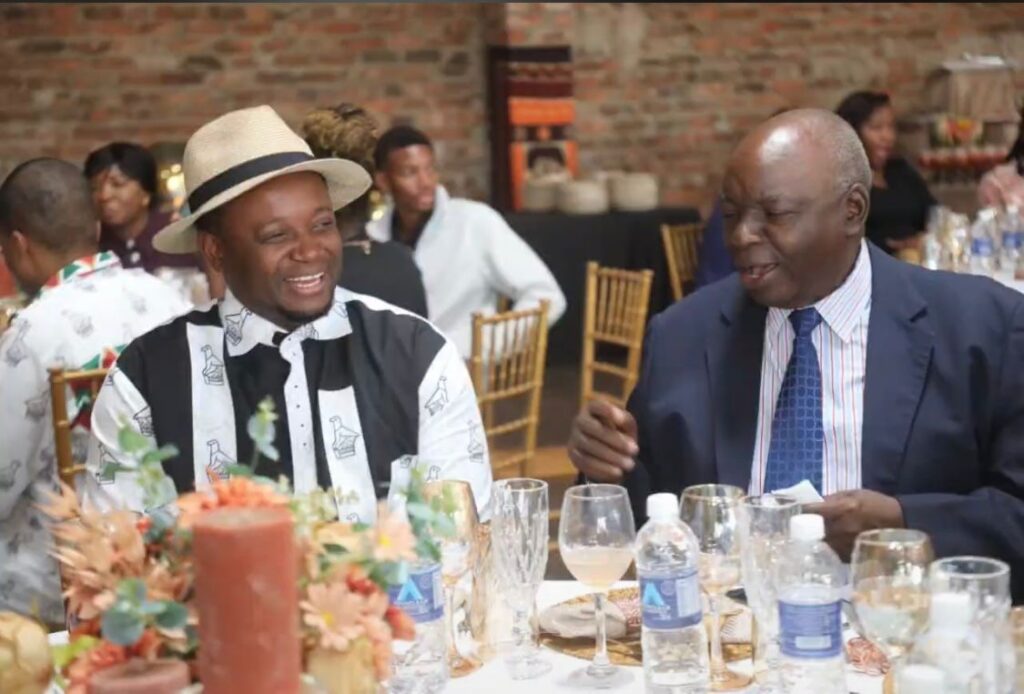
Prof Simbi and INSTAK CEO Ambassador Kwame Muzawazi.
Vice President Mohadi, standing before a crowd that included family, surviving liberation war comrades, diplomats, and INSTAK officials, paid tribute to a figure he called “an unbreakable bridge between the law and the liberation struggle.”
“Professor Mubako did not carry a gun in the bush,” Mohadi said. “But he carried something just as dangerous to the colonial regime: a sharp mind, a just heart, and a legal argument that could not be defeated. We are here today to say thank you. Not just as a government. As a nation.”
The choice of venue was deliberate. Liberation City, anchored by the Museum of African Liberation, is Mubako’s own late-career masterpiece.
As Chairperson of the Institute of African Knowledge (INSTAK), he has spent his so-called “retirement” building a permanent home for the continent’s liberation memory. On his 90th birthday, that home honoured its architect.
The Question Mugabe Asked
It is impossible to tell Mubako’s story without returning to a single, revealing anecdote – one that was recounted more than once during Saturday’s celebrations.
Decades ago, when Robert Mugabe, Zimbabwe’s founding Prime Minister, asked the young legal scholar how he wished to be addressed – Professor, Learned Friend, Your Lordship, or Your Excellency – Mubako did not hesitate.
“Professor, I suppose. The classroom is where I really belong. But just ‘Comrade’ would be a great honour.”
Those who knew him then say the reply was not false modesty. It was a philosophical position. Titles, Mubako understood, come and go. The work of teaching, of building, of liberating – that endures.
And what a catalogue of titles he has accumulated along the way. First Minister of Justice at independence in 1980. Minister of Home Affairs. Minister of Supplies. High Court Judge. Ambassador to the United States. African Union’s Panel of the Wise. And always, always, Professor.
But on Saturday, as the sun moved across Heritage Village, it was “Comrade” that seemed to fit best.
From Expulsion to Harvard
Born on 20 April 1936 in Zaka District, Masvingo Province, Simbi Veke Mubako seemed marked for trouble – the useful kind.
He was expelled from Gokomere Mission for publicly criticising colonial-era pay disparities between black and white teachers. Transferred to Chishawasha Seminary, he was nearly expelled again – this time for ordering philosophy texts not on the approved reading list. On both occasions, Bishop Haene of Gwelo intervened. The bishop saw a rebel worth saving.
When Mubako decided against the priesthood, Bishop Haene bought him a printing press. In 1958, at just 22, Mubako became one of the first black editors in colonial Rhodesia, helping launch Moto magazine.
From there, the odyssey accelerated. Roma University in Basutoland (now Lesotho). Dublin, where he chaired the Pan-African Students’ Association. The London School of Economics. And finally, Harvard University, where he completed a Master of Laws in 1975.
Along the way, he became a founding member of ZANU in 1963, led the successful legal defence of Commander Josiah Tongogara, and transported ZAPU commanders to meet their embattled comrade in prison.
Arrested in Bulawayo as a suspected “terrorist,” he secured his release with a wedding photograph showing white guests and his Polish best man – proof, he argued, that his fight was with a racist system, not with white people.
The Lancaster House Architect
In 1979, Mubako served on the Patriotic Front’s legal team at the Lancaster House Conference. He did not just witness Zimbabwe’s independence constitution being written. He helped write it.
The following year, Prime Minister Mugabe named him Zimbabwe’s first Minister of Justice. It was a fitting appointment for a man who had spent years defending liberation fighters in colonial courts.
Over the next decade, he moved through multiple portfolios, earning a reputation not for grandstanding but for quiet, effective service. He brought an American legal scholar, Robert Seidman, to the University of Zimbabwe.
He served on the Commonwealth Observer Mission to South Africa in 1992, helping navigate that country’s turbulent transition and meeting Nelson Mandela.
In 1999, he became Ambassador to the United States, representing Zimbabwe in Washington until 2005. In 2013, he joined the African Union’s Panel of the Wise, helping broker peace after Kenya’s post-election violence.
A Love Story Across Continents
None of it would have been possible, Mubako has often said, without the woman who stood beside him on Saturday.
In 1968, at the London School of Economics, the wandering Zimbabwean scholar met Hazel Barbra Christie, a young Jamaican from Montego Bay beginning her medical career. A whirlwind courtship became a passionate relationship, then a marriage in 1969 that has now spanned 57 years.
Dr Hazel Mubako became a distinguished physician, graduating in Zambia in 1980 and dedicating herself to public healthcare across Africa. Together, they raised five children – Phillippa Chipo, Dr Takawira Veke, Revai Serudzai, Pfumo Nyika and Pepukai Simbi – and are grandparents to seven.
On Saturday, as Vice President Mohadi spoke, Dr Hazel sat in the front row, occasionally reaching for her husband’s hand. It was a small gesture. But for those watching, it spoke louder than any speech.
‘Teacher waPresident’
In August 2025, Mubako published Zimbabwe @ 45: The Struggle for Sovereign Autonomy and Prosperity – a chronicle drawn from his own lived experience at the centre of the nation’s history.
When he presented the book to President Emmerson Mnangagwa, the Head of State greeted him with three words that compressed nine decades into a single phrase:
“Teacher waPresident!” – The President’s teacher.
It was the same title Mubako had claimed decades earlier, when Mugabe asked how he wished to be addressed. Not Excellency. Not Lordship. Professor. Comrade. Teacher.
At 90, as Liberation City rises from the Harare earth – a monument to African liberation that Mubako has willed into being – the title fits better than ever.
Vice President Mohadi, concluding his remarks, turned directly to the birthday celebrant.
“You taught presidents,” Mohadi said. “You taught judges. You taught ambassadors. But most importantly, you taught us that a title is not what you are called. It is what you do. Happy 90th, Comrade Professor. The classroom is still open.”
The old man smiled. Then he rose to speak. And for one more afternoon, Zimbabwe sat at his feet.
About Author

