

BY DR TONY M MONDA
Legendary First-Generation Sculptor John Takawira with his work “I listen to the rhythm of the stone and let it speak in its own voice – each stone has a spirit and within it, mine is to release it!” – Zimbabwean stone sculptor John Takawira (1981).
Those were the visionary words of John Takawira, a founding member of the original Vhukutiwa group of Shona stone artists that carved the legacy of their Shona culture in stone.
Takawira was a notable figure in the history of Zimbabwean stone sculpture. His subjects were drawn mainly from traditional folklore and the legendary characteristics attached to many animals and birds in Shona lore. His work provided important inspiration for his peers and the second generation of Zimbabwean stone sculptors.
A long-time art connoisseur, collector and family friend to the Takawira’s, Dr. Michelina Andreucci, proprietor of Springstone Art Gallery of Avondale says: ‘John Takawira was a very special person with a tremendous command of his medium. He almost made the stone speak … his rugged style expressed distinct Shona gestures and mannerisms eloquently; John’s art was historically, culturally and socially relevant for the nation. Even after a hundred years his works will still tell a tale”.
Born in 1938, at Marshall (Hartley), Chegutu, in Mashonaland West Province, John Takawira was the son of an ex-policeman and District Commissioner. His mother, Amai Takawira, was an exceptional woman who combined pottery, story-telling and subsistence farming with raising a family. She had a profound influence on the family of three brothers; John, Bernard and Lazarus, who all became accomplished world-famous sculptors. Amai Takawira, singlehandedly raised the family in the Nyatsatse Village north of Nyanga.
Lazarus Takawira was the last surviving sibling of the Takawira sculpture legacy. He died of COVID- 19 related health complications in 2021.
The first-born son of Amai Takawira, John Takawira completed his basic education at Mellory Mission School. On leaving school he was taught to sculpt in the 1960s, by his uncle Joram Mariga. In 1962, when he was 24 years old, Takawira’s work was first shown in a group exhibition at the National Gallery of Rhodesia (Zimbabwe). Although this earned him his first critical acknowledgment, it was not until 1965, three years later that he was singled out by Frank McEwen, the first director of the National Gallery, and became involved in the National Gallery Workshop School.
Between 1969 and 1976 Takawira worked with group of sculptors at the Vhukutu Sculpture Community in the Nyanga Mountains. An open bush land that was informally linked to the National Gallery ideally situated close to a stone quarry. Vhukutu provided a creative haven for Takawira and his peers, included Paul Gwichiri, Sylvester Mubayi, Joram Mariga, Chrispen Chakanyuka and Bernard Manyandure.
Takawira’s work has been exhibited all over the world and some of his work has been purchased by the British Royal Family. He broke onto the International art in 1968 at the “New African Art” group exhibition held at the Museum of Modern Art – MOMA, New York, under the auspices of the Rhodes National Gallery whose founding director, Frank McEwen, was very influential in bringing this new group of sculptors to the attention of the international art community.
The group exhibition toured many American cities, with a high level of interest shown in the art and culture of Africa, At the age of 32, in 1969, Takawira’s work was represented in the 13th Annual Exhibition, held at the Rhodes National Gallery. His work was further celebrated at an exhibition at the Musée d’Arte Modern in Paris, in 1972.
In the late 1970s he introduced his rugged polished surfaces contrasted with a rough, sometimes unpolished texture, in his sculpture, an aesthetic approach which won him the First Prize in the National Gallery of Zimbabwe’s Nedlaw Exhibition in 1981. Believing large pieces radiated more power, He often produced powerfully large work; one such piece entitled ‘Chapungu’ was installed outside the National Gallery in 1986.
Among other works in the National Gallery’s permanent public collection are: ‘Master Mind’, ‘Hornbill Man’, ‘Chapungu’, ‘African and Queen’. Many smaller cabinet pieces also feature in the Gallery’s permanent collection.
In 1986, in recognition of his outstanding contribution to the development of contemporary art in Zimbabwe John Takawira was made an “Invited Artist” at the National Gallery of Zimbabwe’s combined Annual Baringa and Nedlaw Exhibitions.
The authority and influence of his mother Amai Takawira, is evidenced in the theme of matriarchy and the celebration of womanhood in his work. The facial features in “Woman of the Tribe” (©1986), and “Proud Woman” (© 1987), bore an uncanny resemblance to his mother. Takawira’s contemporary interpretation of mature women in regal upright positions with elaborate hairstyles incorporated the same sensibilities.
Works created by Takawira long before the era of gender-awareness and equal rights were recognised globally. His portrayal of women as intellectual, spiritual and practical leaders of the community can be best seen in his sculptures entitled “Shona Queen” and “Wise Woman”.
Takawira was a natural storyteller. A fellow sculptor, Paul Gwichiri, commented: “He could sculpt the same subject four times and yet each piece would have a different story to tell”. This was evident in the artist’s numerous renditions of the “Chapungu” (Eagle) in which he used the subject as a vehicle for the expression of a variety of statements.
As an artist he searched for universal truths in Shona life and mythology.
A recurrence of his more rugged style always coincided with personal grief or a crisis in his life. This was especially notable in his artwork entitled “Spirit of the Sculptor” which he produced after
serving an eighteen-month jail sentence with other political detainees in a prison camp. The work was created in protest of his untried imprisonment at the beginning of Zimbabwe’s Liberation War (1965-1979), when the artist was arrested for carrying stones.
The days of civil war in the then Rhodesia, were marked by urban unrest and industrial strikes and riots. Takawira was apprehended while ferrying stones from Nyanga to Highfield in Harare, where he lived and worked. Under the Emergency Powers Act and the Law-and-Order Maintenance Act issued in July 1960, by the Whitehead Government and the Martial Law Act of the UDI Rhodesian regime in 1965, it was perceived by the authorities as “possessing dangerous weapons with intent to carry out subversive activities”
The years that followed his discharge from prison were no less troubled. Despite the artist’s international exposure, the Rhodesian authorities of the time, viewed sculpture communities as a ‘potentially subversive group’. In their eyes, the works of art were viewed as a “means of passing encoded messages to and between the liberation fighters”; which in reality, some artists have confessed to be true; Such as the “Chapungu” the Bird of Zimbabwe (which was controversial at that time), and “The Liberator”, which like Thomas Mapfumo’s song “Tumirai vana kuHondo”, was encouraging people to fight for their liberation.
For John Takawira, the politically unstable decade of the 1970’s inspired a change in style and subject matter; symbols of death and spiritual escape became dominant in his work. Graphic and haggard images of eagles, owls and skeletons began to appear.
These can be seen as both symbols of Shona mythology, which was used to foretell current events, as well as a reaction to the social instability at the time. This was also a time when the formally buoyant art market was disrupted by the civil war. The number of visitors to the country fell from over 500 000 in 1972, to less than 64 000 in 1978 due to the civil unrest in pre-independent Zimbabwe.
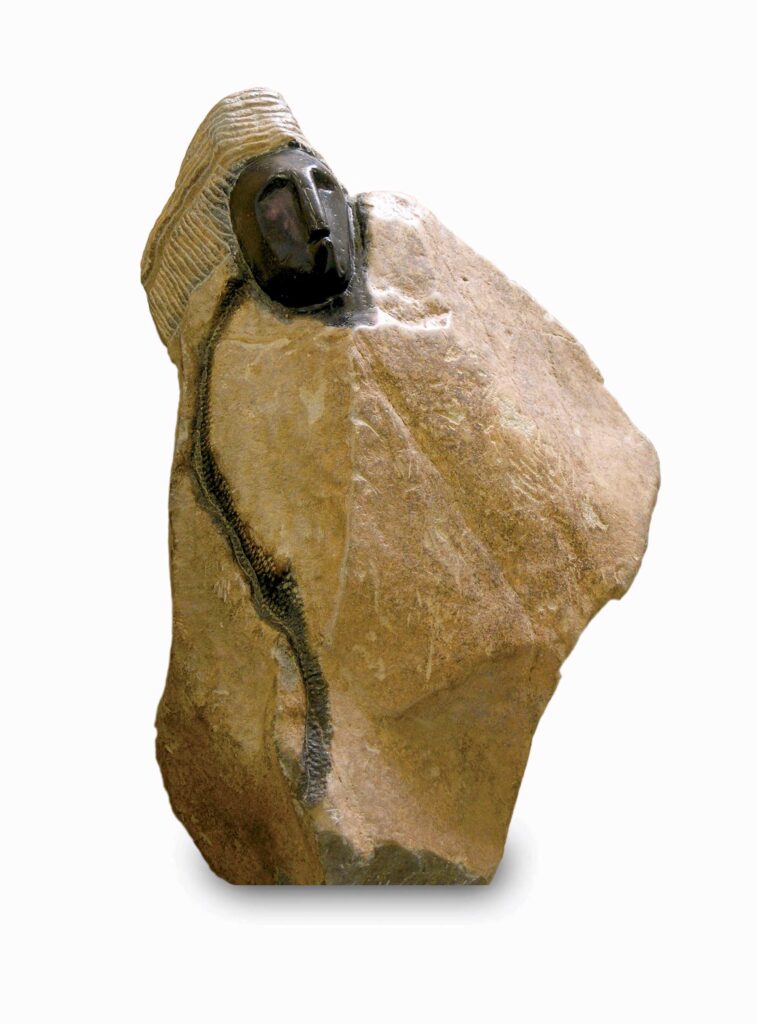
In 1987, John Takawira was diagnosed diabetic and during his last years his work became more introspective and unpredictable in style. A typical example of his last period is “Old John in his Blanket” © (1986). Here, the style is restrained and form-free. “Old John in his Blanket” was perhaps an expression of the artist’s physical state of mind at the time before his passing in 1989.
On September 14, 1987, an article in Newsweek (New York) read “Shona sculpture is perhaps the most important new art form to emerge from Africa in this century . . . It has arrived on the international art scene … collected by Prince Charles (now King of England), Queen Sophia of Spain, Sir Richard Attenborough, Cicely Tyson, Miles Davis ,the Rockefellers and the Rothschild’s . . . ” John Takawira was amongst them
Some of John Takawira’s best works lie in the collections of royalty, celebrities and world billionaires today. A selection of international exhibitions include:
1965 Commonwealth Art Festival, New Arts of Rhodesia, Royal Festival Hall, London
1968/69 New African Art; the African Workshop School, Museum of Modern Art, New York
1969 Contemporary African Arts, Camden Arts Center, London
1970 Sculptures Contemporaine de Vukutu, Musée d’Art Moderne, Paris
1971 Sculptures Contemporaine de Shona d’Afrique, Musée Rodin, Paris
1972 Shona Sculptors of Rhodesia, Institute for Contemporary Arts, London
1979 Art from Africa, Staatliche Kunsthalle, Berlin
1981 Art from Africa, Commonwealth Institute, London
1986 Soul in Stone, Alandale Center, Perth
1990 Sculptures Contemporaines du Zimbabwe, Musée National des Arts Africains, Paris
1990 Commonwealth Festival of Arts, Auckland
1993 Art from Africa, masterpieces of the Peus Collection, Ludwig Forum, Aachen
1995 Old Masters, New Signatures, Springstone Art Gallery, Avondale, Harare
1996 Spirits in Stone, Springstone Art Gallery, Avondale, Harare
1998 Zimbabwe, Stenen Getuigenissen, Africa Museum Tervuren
2000 Soul in stone, Museum Alpin, Pontresina
John Takawira, who died in November 1989, left a rich legacy for future Zimbabwean generations to view with pride. Many of his seminal artworks cab be appreciated at Vhukutu Gallery in Blakeston Avenue, Springstone international Art Gallery on 5 Idlehurst Way, Avondale, Chapungu Sculpture Park in Msasa Harare and a few at the National Gallery of Zimbabwe. In retrospect it is sad to note that it has taken us over two decades to honour this notable Zimbabwean icon.
Dr Tony M Monda holds a PhD. in Art Theory and Philosophy and a DBA in Post-Colonial Heritage Studies. He is an arts, culture and music critic for Gemnation News. For Comments E-mail: tonym.MONDA@gmail.com
About Author

